On the Cover The “Liberty Valve” as once sold by the Radio Apparatus Co. of Pottstown, Pa In this issue
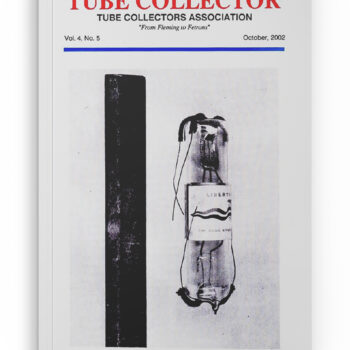

On the Cover The “Liberty Valve” as once sold by the Radio Apparatus Co. of Pottstown, Pa In this issue
On the Cover A pre-prototype leading to the Eimac 304T, from an affidavit filed by Ronald H. Gordon, laboratory glassblower. He certified having made the tube “before1940.” The objective was to contest, successfully, a claim of inventing a “plurality of grids in an envelope” in a patent application by Harold Zahl of the Signal Corps....
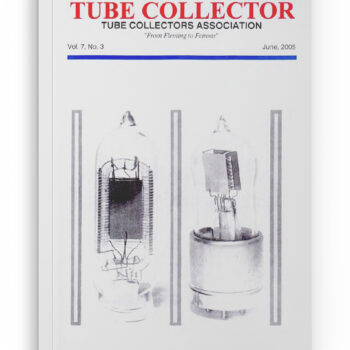
On the Covers Two halves of a composite four-tube photo, from the De Forest Radio Co. A 10-1/2 X 19-1/2 print of this image turned up in the recent Boyer Estate auction conducted by the CC-AWA group. This is quasi-historic stuff: spired article in Raadio News, May, 1930. In this issue
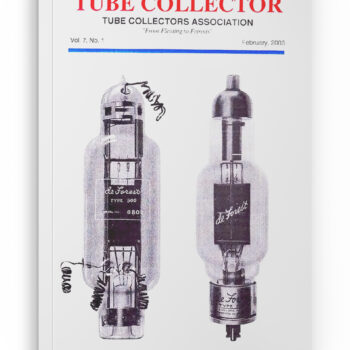
On the Cover A reproduction of De Forest catalog art: images of the 500 and 504A triodes. The artist’s originals can be yours, via the CC-AWA auction planned for March. See p. 1 for details. In this issue
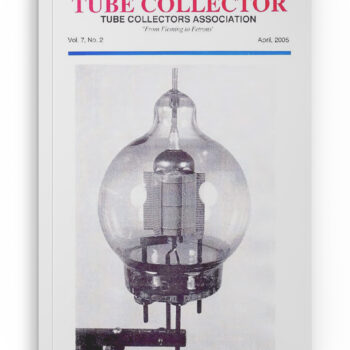
On the Cover The Eimac X-4 developmental triode of June, 1942; one of many versions that finally led to the 527 radar tube. The anode is from the 250T. Filament drain is 7.5v@30A. In this issue
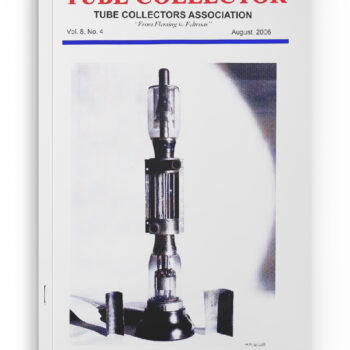
On the Cover A Western Electric 240A with the radiator and anode cut away to show internal construction. Note that the water inlet and oulet fittings are displaced from each other, presumably to induce a spiral flow of the colling water. Photo from the late Bell Labs Historical Museum. In this issue
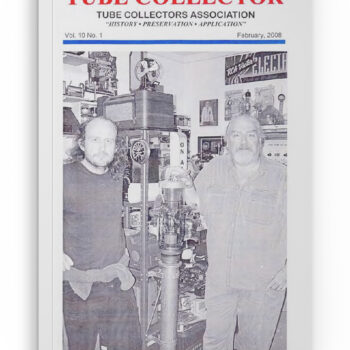
Daniel Stocks, Australian microwave-tube expert, left visits Ron Lawrence and his “Radio Heaven” display in North Carolina. Photo: Robert Lozier. In this issue
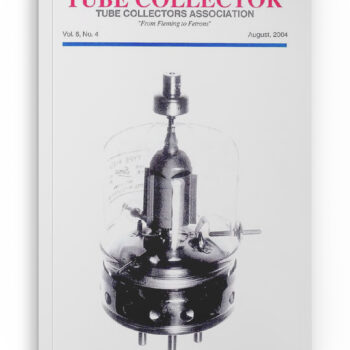
On the Cover The Eimac X272 developmental tetrode from 1944 – a 4-125A with three radial pins added to reduce lead inductance. In this issue
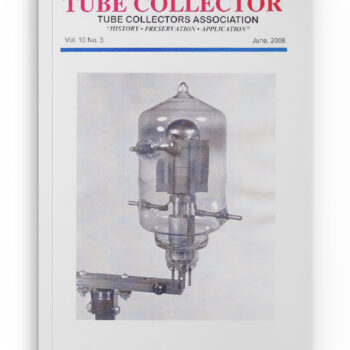
The Eimac X-8 triode of July, 1942, one of the Umpteen proto-types that led to the 527 power tube. In this issue
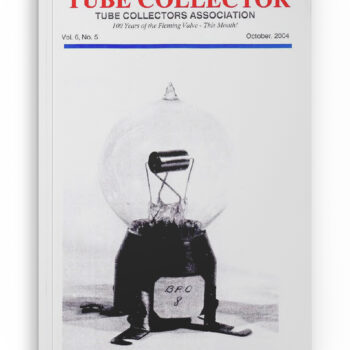
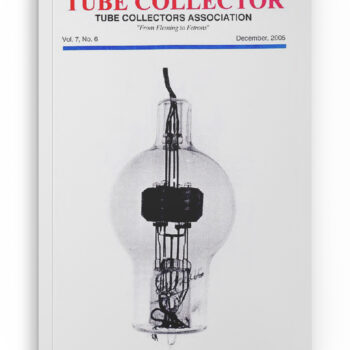
On the Cover This appears to be British Post Office “Valve Amplifing No. 1,” made by BTH, as discussed in Keith Thrower’s British Radio Valves – The Vintage Years; 1904-1925. The photo is of a sample in the long-abolished tube museum at Bell Laboratories. Photo: Bell Labs, courtesy of Jerry Vanicek. In this issue